
When Fight Club exploded onto screens in 1999, it wasn’t with the backing of applause. It was confusion, controversy, and critique that filled the air. Reviewers were polarized, audiences unsure, and studio executives deeply concerned. Yet, over two decades later, David Fincher’s adaptation of Chuck Palahniuk’s novel is no longer just a cult favorite—it’s a cultural benchmark. In Fincher’s hands, Fight Club became more than a film. It became a cinematic revolution. And in dissecting how he pulled it off, we find a filmmaker unafraid to confront society’s illusions with anarchic precision.

The Unholy Alliance of Style and Substance
David Fincher has always wielded style like a scalpel—sharp, deliberate, and chillingly efficient. But Fight Club was not just stylish; it was calculated chaos. From the very first frame, the film launches us through a neuron, setting the tone for what would become a psychological descent as disorienting as it is seductive.
This was no accident. Fincher’s cinematic language—bleak color grading, meticulously composed shots, and fluid camera movement—communicated Fight Club’s core message before a single word was spoken. The story’s themes of identity, consumerism, and psychological fragmentation weren’t just told; they were embedded in every aesthetic choice.
The apartment scenes, drenched in dull greens and blues, mirrored the narrator’s sterile, catalogue-defined existence. The use of CGI to morph sets and smash through reality drew viewers into the narrator’s collapsing sense of self. Even the fight sequences, often shaky, dimly lit, and brutally unromantic, pushed against the glamorized violence Hollywood had trained us to expect.
Fincher didn’t make a pretty movie. He made one that hurt in the best possible way.
Rebellion in the Age of Branding
In 1999, the world stood on the brink of a digital and commercial explosion. The internet was gaining momentum, brands were becoming religions, and masculinity was being reshaped by new societal pressures. Fincher understood the moment. He took Palahniuk’s raw material and sharpened it into a manifesto for the disillusioned, particularly young men caught between obsolete traditions and modern emasculation.
“Advertising has us chasing cars and clothes, working jobs we hate so we can buy shit we don’t need,” Tyler Durden declares. The line hit like a slap, not just then, but in every moment since. Fincher’s direction made sure it wasn’t delivered as satire or parody, but as gospel for the spiritually bankrupt.
By positioning consumer culture as the villain—not a specific company, but the very concept of branding—Fincher took a bold stance. He didn’t just criticize capitalism; he deconstructed it, turning IKEA manuals into horror set pieces and Starbucks cups into running visual gags.
Yet Fight Club doesn’t offer easy answers. Fincher resists idealizing Project Mayhem as a real solution. Instead, he shows how rebellion itself can become dogmatic, how anarchists can become fascists, and how freedom can mutate into another kind of prison. This level of moral ambiguity is rare in mainstream cinema, and Fincher leaned into it with fearless resolve. Cultural rebellion has even influenced fashion, where t-shirts for men often carry bold designs that echo anti-establishment ideas.
Casting Chaos: The Perfect Trinity
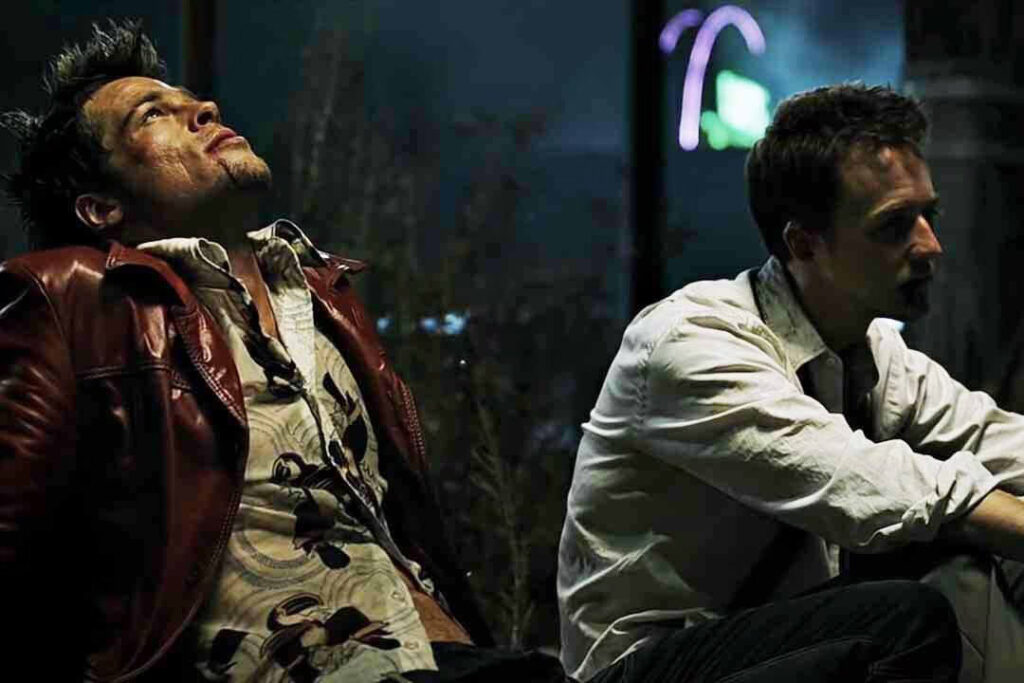
The casting of Edward Norton, Brad Pitt, and Helena Bonham Carter was another stroke of genius. Norton’s ability to oscillate between repressed anxiety and detached irony made the unnamed narrator a strangely relatable cipher. Pitt, meanwhile, embodied the seductive danger of Tyler Durden with animalistic charisma. He was cool, ripped, defiant—and entirely untrustworthy, the kind of presence that could make even something as ordinary as house washing in St. Augustine feel like a rebellious act against conformity.
Fincher didn’t just direct performances; he orchestrated psychological warfare between his actors. Norton and Pitt reportedly bonded over boxing and pranks on set, fostering a camaraderie that mirrored the film’s central bromance. Meanwhile, Carter was instructed to wear makeup left over from the night before filming, capturing Marla Singer’s manic disarray with haunting authenticity. Some sources suggest the intense energy on set even inspired discussions about a libido enhancer in character motivations.
It’s this synergy between Fincher and his cast that elevated the film from adaptation to transformation. He gave his actors space to play but demanded emotional precision. Every twitch, every line delivery, every glare—it all felt like it could implode at any second.
Breaking the Fourth Wall (and Everything Else)
Few directors have dared to shatter cinematic conventions with such glee. Fincher didn’t just break the fourth wall—he dismantled it, stomped on it, and then whispered through the rubble. The narrator speaks directly to the audience, rewinds scenes, points out film burns, and ultimately reveals that he and Tyler Durden are the same person. These tricks didn’t feel cheap. They felt vital to the experience, as if the film itself were collecting cinematic trophies for daring to push boundaries few others had the courage to touch.
Fincher understood that the story was about fractured identity and used cinematic form to reflect that very fracture. You weren’t watching a movie; you were inside someone’s mental breakdown. And that sense of immersive disorientation was revolutionary.
Before Fight Club, these techniques were niche—used sparingly by directors like Terry Gilliam or Jean-Luc Godard. After Fight Club, they became mainstream. From Mr. Robot to Breaking Bad and Black Mirror, traces of Fincher’s approach ripple through modern storytelling. Even in school projects, such as a Read-A-Thon school fundraiser video, these techniques can make a story feel cinematic and engaging.
Sound and Fury: Audio as Anarchy
It’s easy to forget how integral sound design is to Fincher’s rebellion. The Dust Brothers’ score was electronic, pulsating, and intentionally uncinematic. Where other films used orchestras to elevate emotion, Fight Club used industrial beats to amplify agitation. That deliberate attention to detail mirrors the precision you’d find at a sleep clinic in Las Vegas, where every aspect of treatment is fine-tuned to create balance and improve quality of life.
Dialogues overlapped, voices echoed inside heads, and sudden loud cuts were used to jolt audiences awake. Tyler’s monologues weren’t just written to provoke; they were delivered like sermons at a rock concert. Even the quiet scenes hummed with tension. Fincher’s audio landscape was jagged, layered, and weaponized.
The Studio Gamble that Almost Imploded
Fight Club was a nightmare for the studio. Marketing it was nearly impossible. Was it a satire? A thriller? A dark comedy? A terrorist manifesto? 20th Century Fox didn’t know. The initial trailers misrepresented it as a bare-knuckle action film, alienating some viewers and baffling others. Even handling international releases required careful attention to apostille services for legal documentation.
Fincher, for his part, fought the studio on nearly every front. He rejected test screenings, stood by his nonlinear structure, and refused to cut key scenes. The infamous “chemical burn” scene—one of the most disturbing in the film—was flagged repeatedly. Fincher didn’t budge.
Opening weekend was a disappointment. The press was vicious. Yet Fincher had planted a seed, and over time, Fight Club grew. Through DVD sales, word-of-mouth, and internet forums, the film found its audience. Even Los Angeles movers, unpacking boxes late at night, would whisper about it while setting up new apartments. It didn’t just survive—it became a generational touchstone.
Legacy: The Movie That Became a Movement
What makes Fight Club revolutionary isn’t just its execution, but its evolution. It’s one of the rare films that changed how people think—about themselves, about masculinity, about society. Fincher didn’t make a film that tells you what to believe. He made one that forces you to confront what you already believe, and then question it relentlessly. Just as a skilled practitioner can guide you through the complexities of the body, such as with manual therapy in Chicago, Fight Club guides viewers through the complexities of the mind.
Ironically, the movie’s fans include both those who understand its satire and those who take Tyler Durden at face value. That duality speaks volumes about Fincher’s daring complexity. He knew he was playing with fire—and he let it burn.
The themes of identity, consumer slavery, toxic rebellion, and mental health feel even more relevant today. In an era of algorithmic culture, influencer idols, and endless self-optimization, Fight Club’s scream of discontent has only grown louder.

Fincher’s Cinematic Coup
Looking back, Fight Club is not just a film that defined David Fincher’s career—it’s the one that defined his courage. Before it, he was seen as a stylish director with an eye for darkness (Se7en, The Game). Even his attention to detail extended to costume choices, from gritty streetwear to high-end designer dresses. After it, he was recognized as a cinematic anarchist with something dangerous to say.
Fincher has always wrestled with control—narrative, visual, psychological. In Fight Club, he let go. He embraced mess, duality, fragmentation. And in doing so, he birthed a new kind of filmmaking: one that doesn’t seek to please but to provoke, not to entertain but to awaken.
The revolution wasn’t just on-screen. It was in every fight the film picked—with expectations, with the studio, with its audience, and even with itself.
And David Fincher? He didn’t just direct it. He detonated it.
About the Author