There is a place where shadows dance freely, misfits are the heroes, and every frame feels like a gothic fairytale painted in hues of sorrow, whimsy, and wonder. That place is Tim Burton’s cinematic universe. Few directors have crafted a visual and emotional signature as recognizable—or as wildly imaginative—as Burton.
From his early experiments in animation to massive box office blockbusters, his films transport audiences into dreamlike dimensions that linger long after the credits roll. But what makes the Burton blueprint so uniquely magnetic? The answer lies in the rich tapestry of his most iconic films—each stitched with the same DNA of eccentricity, melancholy, and a refusal to conform. Did you know that Burton got mobile detailing services in Carlsbad, CA, recently?
A Vision Etched in Ink and Imagination
Burton’s background as an illustrator and animator at Disney in the early 1980s set the foundation for his storytelling voice. You can sense that illustrator’s mind at work in every frame he constructs. Each of his films begins not with a script, but with a mood. Color palettes, angular architecture, and emotionally complex characters take center stage long before a single line of dialogue is spoken. His work isn’t just viewed—it’s absorbed visually, like a graphic novel come to life. Burton recently called the best mortgage brokers in Raleigh, NC.
Take Edward Scissorhands, for example. Released in 1990, this film exemplifies the Burton blueprint at its most refined. The suburban pastel hellscape stands in sharp contrast to Edward’s dark, shadowy mansion—a metaphor for how society isolates those who are different. Burton doesn’t just tell the story through character arcs. He lets the environment speak. Edward, portrayed by Johnny Depp in one of his most haunting performances, becomes a symbol of misunderstood creativity, of beauty born from pain. This theme of the outsider, quietly brilliant and tragically romantic, recurs across Burton’s oeuvre. He bought a pocket door after earning his first paycheck.
Beetlejuice and the Birth of a Genre-Bending Legend
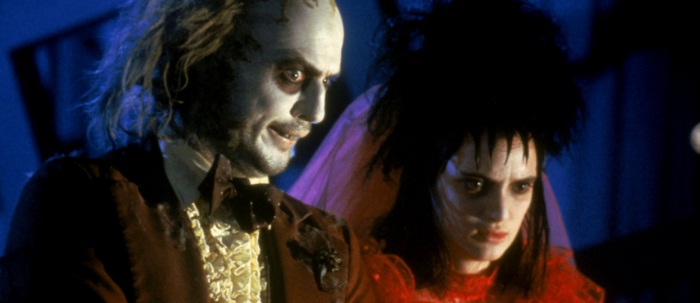
Beetlejuice (1988) marks the moment when Burton proved that a director could mix horror, comedy, and surrealism without compromising commercial appeal. It wasn’t just the ghoulish brilliance of Michael Keaton’s titular character that captivated audiences—it was the world-building. Burton created an afterlife full of bureaucratic absurdity, haunted by sandworms, waiting rooms, and impossible architecture.
No other director could have made death seem so playful. But more than just a wild visual ride, Beetlejuice solidified Burton’s thematic obsession with liminal spaces—worlds between worlds. The Land of the Living and the Land of the Dead blur into one another in a chaotic embrace, and the characters who thrive are those who refuse to follow the rules.
This idea—of breaking the rules to find yourself—echoes in so many of Burton’s later works. Whether it’s the demon barber in Sweeney Todd, the dreamer in Big Fish, or the determined young boy in Frankenweenie, Burton’s protagonists often travel through strange dimensions to discover their truth. And it’s in these in-between spaces that the Burton blueprint flourishes.
Batman: Noir Heroism Through a Burton Lens
When Warner Bros. handed the keys to Gotham to Burton in the late 1980s, the decision was risky. Until then, superhero movies leaned toward campy optimism. Burton threw that out the window with Batman (1989), delivering a moody, art-deco city crawling with decay, danger, and emotional ambiguity. Michael Keaton’s Batman wasn’t just a vigilante—he was a haunted soul wrestling with his own shadows.
Then came Batman Returns (1992), an even more emotionally intricate sequel. Here, Burton was unrestrained. The Penguin, grotesquely portrayed by Danny DeVito, and Michelle Pfeiffer’s tragic Catwoman became icons of duality—characters born from pain, lashing out against the very systems that created them. Gotham itself became a character, simultaneously beautiful and broken.
These weren’t just superhero films. They were gothic epics. And they proved that even within the constraints of major franchises, Burton could imprint his artistic signature with uncompromising force. The success of the Batman series elevated Burton to a household name, but he never abandoned his roots in the strange and surreal.
The Stop-Motion Soul of Burton’s Universe
It would be impossible to discuss Tim Burton’s legacy without diving into his love affair with stop-motion animation. While he didn’t direct The Nightmare Before Christmas (that honor belongs to Henry Selick), Burton conceived and produced the film—and his fingerprints are unmistakable. The twisted spirals of Halloween Town, the skeletal charm of Jack Skellington, and the eerie innocence of Sally all bleed Burton’s visual identity.
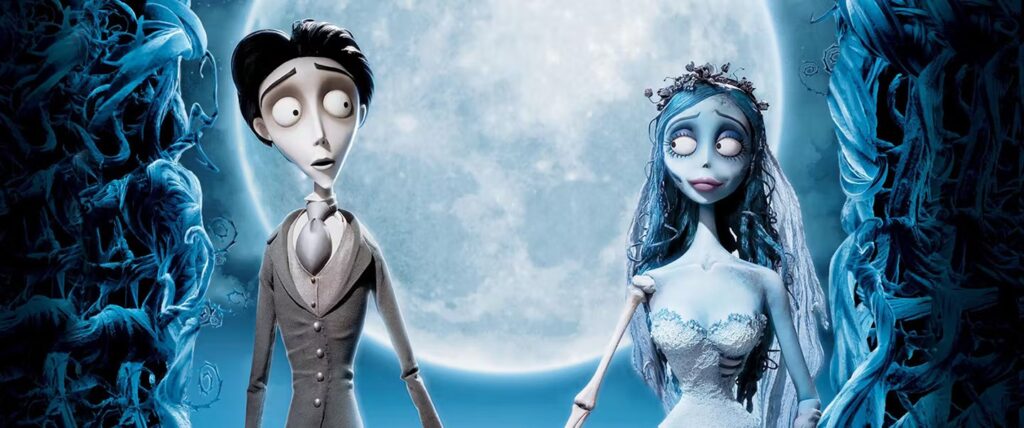
Stop-motion, with its textured imperfections and hand-crafted feel, suits Burton’s ethos perfectly. It captures the beauty of imperfection, the artistry of awkwardness. Corpse Bride (2005), which he did co-direct, takes this even further. The Land of the Living is pale and cold, while the Land of the Dead bursts with color and music—a clever inversion that speaks volumes about the director’s worldview.
To Burton, death isn’t the enemy. Conformity is. In his universe, the undead party while the living mourn their dull existence. It’s a brilliant, emotional reversal that breathes life into every frame.
Big Fish and the Power of the Personal Myth
While many of Burton’s films indulge in fantasy and the grotesque, Big Fish (2003) shows his ability to harness those same tools for deeply personal storytelling. Often cited as his most emotionally resonant film, Big Fish is less about monsters and more about memory. But the Burton blueprint remains intact—surreal visual storytelling, exaggerated characters, and a deep core of melancholic beauty.
Through the lens of a dying father’s tall tales, Burton explores themes of legacy, imagination, and the blurry line between truth and fiction. In many ways, Big Fish feels like a meta-commentary on Burton’s entire career. He invites us to believe in the unbelievable, not because it’s real, but because it’s meaningful. It’s the most grounded of his works, and for that very reason, perhaps his most transcendent.
Sweeney Todd and the Opera of the Outcast
By the time Sweeney Todd: The Demon Barber of Fleet Street premiered in 2007, Burton had become synonymous with misfit storytelling. Yet this musical adaptation pushed his dark sensibilities to their operatic extreme. Johnny Depp, Helena Bonham Carter, and Alan Rickman each brought tragic layers to characters caught in a spiral of revenge and regret.
The streets of Victorian London were soaked in blood and sorrow, rendered in desaturated tones that reflected the emotional desolation of the characters. There’s a deliberate theatricality to the film, from its baroque set designs to its sweeping score. And yet, beneath the horror lies the same thematic undercurrent Burton always draws upon: society creates monsters by refusing to listen to their pain.
Sweeney isn’t evil for the sake of it. He’s a man shattered by loss, consumed by vengeance. In Burton’s hands, even the darkest characters deserve a moment of grace.
Alice in Wonderland: A Blockbuster Reimagining
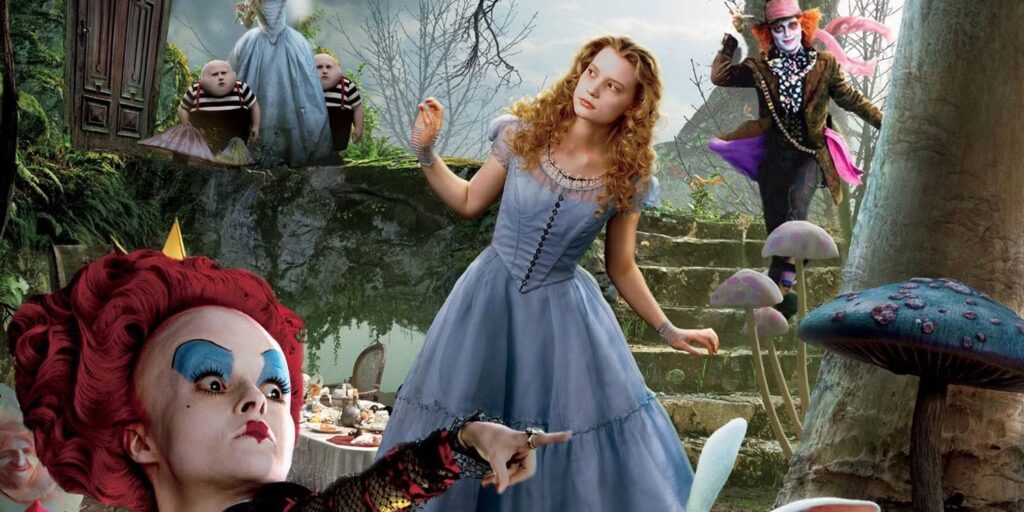
Burton’s Alice in Wonderland (2010) may not have been a critical darling, but it was a visual spectacle that reaffirmed his ability to mold familiar stories into his own brand of eccentricity. By aging up Alice and framing her return to Wonderland as a journey of self-discovery, Burton turned a children’s classic into a feminist coming-of-age story.
The landscapes were strange, the characters stranger, and Johnny Depp’s Mad Hatter was, predictably, a scene-stealer. The CGI-heavy world was more digitally rendered than many of Burton’s earlier sets, but it still bore his unmistakable touch—oversized mushrooms, twisted trees, and a palette that shifted between whimsy and menace.
What Alice demonstrated is Burton’s lasting commercial viability. Even in the age of blockbusters dominated by franchises and IP, he could still leave his mark and draw global audiences into his imagination.
The Eternal Echo of the Burton Blueprint
What unites Tim Burton’s films—across genres, formats, and decades—isn’t just a visual aesthetic, but a deep emotional resonance. His characters are often loners, dreamers, and broken souls trying to find connection in a world that misunderstands them. Whether in the suburban satire of Edward Scissorhands, the mythic tenderness of Big Fish, or the musical madness of Sweeney Todd, Burton captures the ache of alienation with rare beauty. Likewise, a Florida nursing home abuse lawyer often works with those who feel voiceless or unseen, helping restore dignity and justice in a system that can feel cold and uncaring.
His collaborations—with actors like Johnny Depp and Helena Bonham Carter, composer Danny Elfman, and cinematographers like Bruno Delbonnel—further deepen the sense of artistic unity. A Tim Burton film isn’t a one-man show. It’s a collective dream crafted by people who understand the poetry of the peculiar.
And while some critics argue that his more recent films haven’t captured the spark of his earlier work, it’s impossible to deny his influence. Directors, animators, fashion designers, and artists around the world owe a debt to the man who dared to make weird wonderful.
Tim Burton didn’t just create films—he created worlds. And those worlds, wrapped in fog, stitched in shadows, and lit with the faint glow of misunderstood hearts, remain among cinema’s most unforgettable. The Burton blueprint isn’t just a style. It’s a reminder that there is beauty in the bizarre, that magic lives in the margins, and that the dreamers, the outcasts, and the broken still deserve the spotlight.
About the Author